
How to Search Attala County Criminal Dockets
Get the court right first. The paper in hand tells you where to search. An Attala indictment belongs to the Fifth Circuit MEC system or the Attala Circuit Clerk. So does any Circuit Court case. An Attala Justice Court matter runs on a separate record path. It covers affidavits, DUI cases, and county-ordinance violations. A Kosciusko city citation or city-limit matter belongs with the municipal clerk instead. Sort that out before typing any name or number. PAMEC is the remote route for participating Attala Circuit material. It needs a registered account, and a broad search gets billed even when nothing matches. A known Attala County case number is the safest search key. With only a name, use the official account's filters with care. Confirm the Attala court and the filing date. Check the party role and the event history too. Only then treat a result as the right case.
- Read the charging paper, ticket, or appearance notice to identify the Attala court and case type.
- For a Circuit case, open the official Attala MEC/PAMEC route and use the case number first when it is known.
- Open the matching Attala County criminal docket and confirm the court, case style, filing date, and charge description.
- Review the dated Attala event list, settings, orders, flags, and any recorded disposition from newest entry to oldest.
- Ask the Attala clerk for the public docket sheet or a copy when a document is unavailable, restricted, or needs certification.
Note: An Attala County search result is a court record trail. It is not a full account of events outside that court.
Attala County Criminal Dockets at Fifth MEC
The online route is the Fifth Circuit MEC gateway. It serves the Attala County Circuit criminal docket. Attala Circuit joined MEC on November 21, 2019. The public side runs through PAMEC. A non-attorney account carries an annual registration fee, and searches are billed by the page. Under the terms, even a no-match result counts as one billed page. A precise Attala County case number saves money compared with repeated broad docket searches.
The official PAMEC registration page lays out three paths: Attorney, Non-Attorney, and Firm Administrator. Non-attorney signup asks for identifying and account details. The username must fit a stated pattern of two letters followed by four numbers. Access stays account based throughout. That structure has limits. It does not turn the Attala County criminal docket into an open public index anyone can browse.
The official PAMEC registration screen shows the account options. Those options govern a remote Attala County criminal docket search.
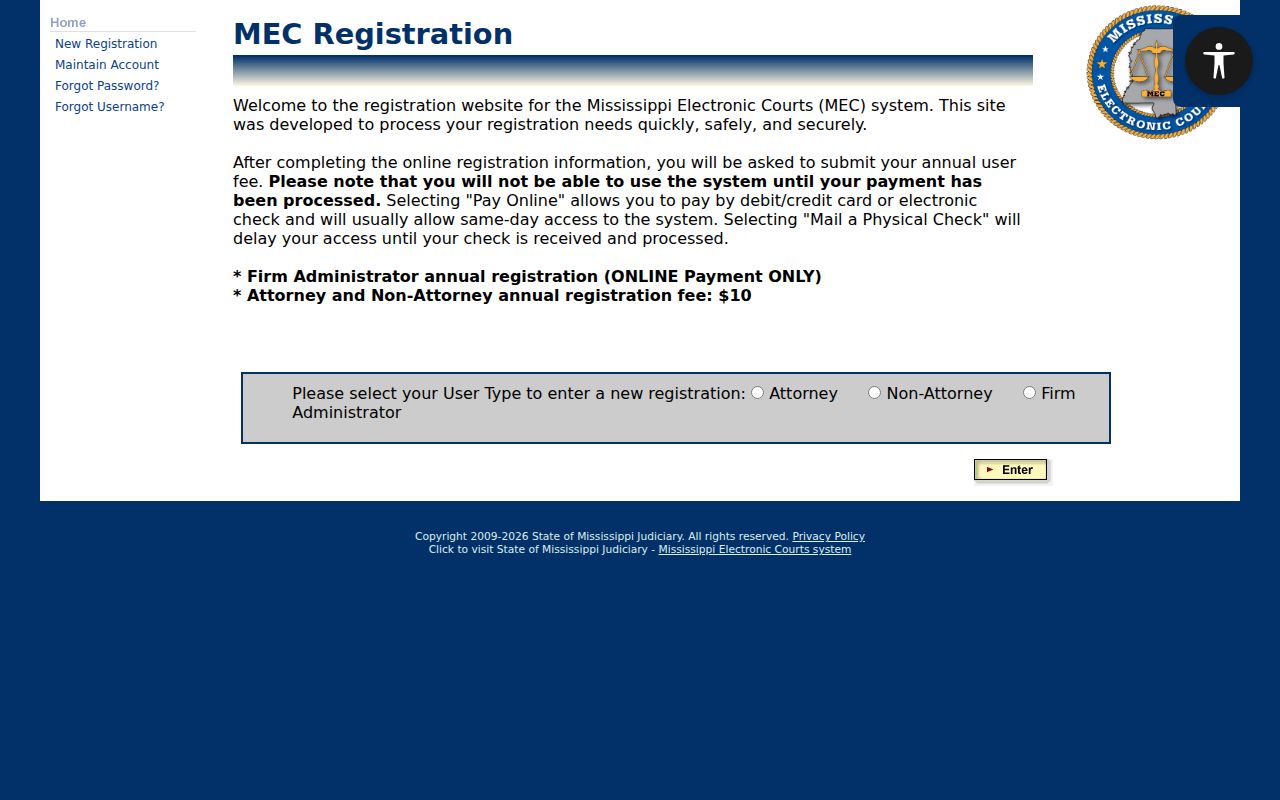
Registration sets up the route. The court and the case information still decide which Attala criminal docket you can actually search. The PAMEC non-attorney terms explain the per-page search charge and the annual account cycle. Under those terms, a page you view, print, or download still counts as a billed search page. Hang on to the official receipt details. Save the date of any Attala County criminal docket search. That paper trail helps if a clerk later needs to track down a record for you.
The official terms screen states the conditions. They apply when PAMEC is used to pull an Attala County criminal docket remotely.
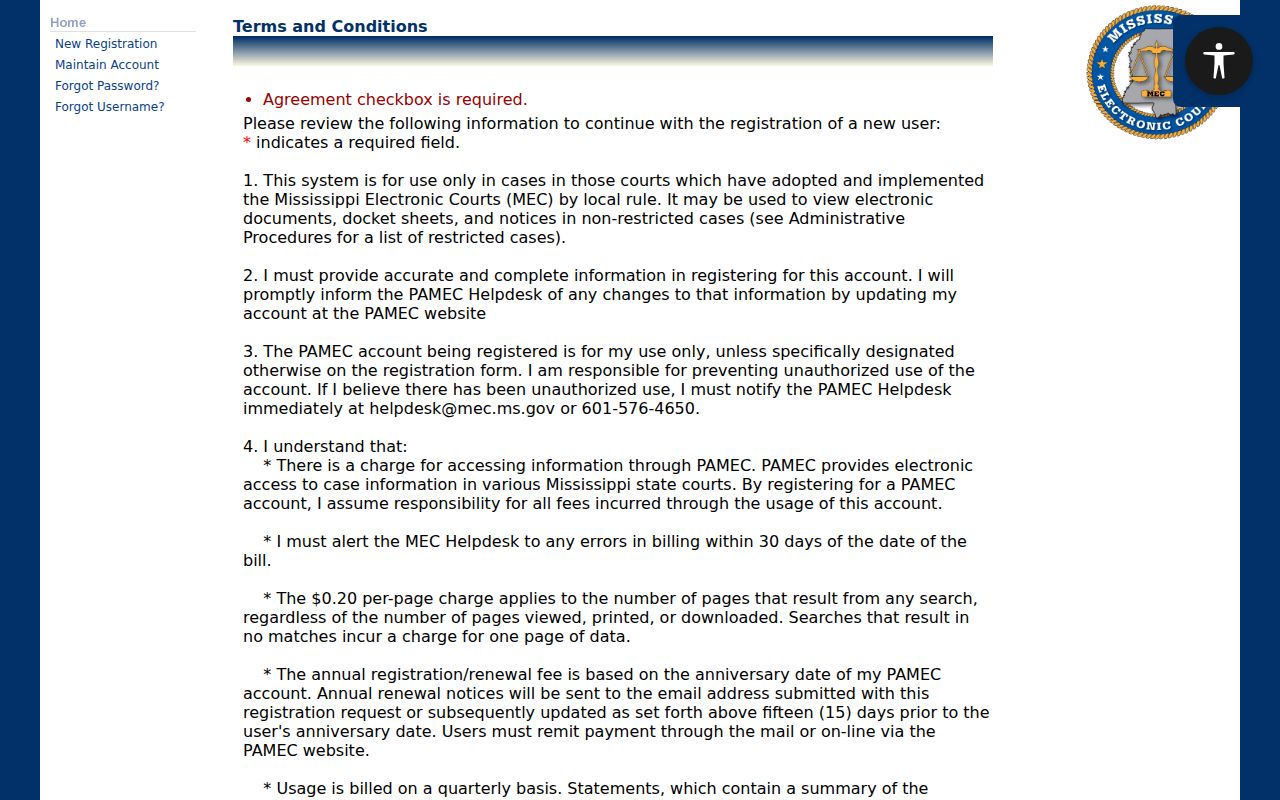
Remote page charges are separate. Any copying, certification, or mailing cost for an Attala record is quoted by the clerk.
What a Criminal Docket Shows
An Attala County criminal docket is a procedural index. The header and timeline identify the court and division, case number, filing or indictment date, case style and roles, charge description, attorneys, settings, documents, flags, disposition, sentence, and closure. That list is what makes it useful. Dated court actions sit in sequence. But read entries carefully. A charge on the docket is not a finding, and a status line never replaces the order it points to.
| Court and division | Confirms an Attala Circuit case rather than an Attala Justice Court or municipal matter. |
|---|---|
| Case number and filing date | Stable lookup anchors for the Attala County criminal docket; no local number format was verified for publication. |
| Case style and roles | Identifies the parties by their Attala court roles without treating the docket as a verdict. |
| Charge or indictment | States the Attala filed allegation, not a conclusion about guilt. |
| Attorneys and appearances | Shows representation and appearance events on the Attala County criminal docket. |
| Docket events and documents | Shows the chronological Attala filings, notices, motions, and orders that shape the case. |
| Settings | Lists an arraignment, motion, trial, sentencing, or other Attala court date; verify the newest entry. |
| Flags | Supplies Attala workflow or restriction clues, not independent outcomes. |
| Disposition, sentence, and closure | Shows the Attala final procedural result only when officially entered. |
In an Attala criminal docket, a linked judgment or order carries more meaning than a short event title. The title alone tells you little. If no public document link appears, ask the Attala Circuit Clerk whether a public copy or docket sheet exists. Bring the court, case number, and filing date.
Attala County Criminal Docket Flags
The Fifth Circuit CourtInfo vocabulary gives an Attala County criminal docket useful but limited status labels. Each flag marks a workflow step or restriction. Pair every flag with its entry date. Match it to a docketed order when one exists, because a criminal status alone is never a safe final result.
- Arraignment pending
- An arraignment step has not yet been completed or entered on the Attala County criminal docket.
- Capias pending or bench warrant
- A court-process or warrant workflow marker. It does not establish service or final resolution.
- Trial pending
- A trial remains on the workflow or calendar. It is not a finding.
- Probation violation pending
- A post-disposition workflow label that needs the dated entry and related order for context.
- Sealed, expunged, closed, appeal, or stayed
- Official Attala docket indicators of access, closure, review, or paused-proceeding status that require careful reading.
Plea pending and trial pending are labels. They do not report a conviction. A closed Attala County criminal docket can still hold documents that are not public. The safe method is matching the flag to the most recent Attala order, judgment, or clerk-confirmed entry. That keeps the status in its procedural context.
Stages on an Attala County Criminal Docket
An Attala County criminal docket may begin with a charging document, affidavit, or later indictment, depending on the court. The procedural line is: Filing → Arraignment → Pretrial → Plea or Trial → Disposition → Sentencing. Motions, settings, notices, and orders may appear between those stages. A later Circuit entry can follow an earlier Justice Court step, but the two courts keep distinct records.
Read each Attala docket stage as a dated court action. The newest setting wins. It can supersede an older one. Confirm any disposition or sentence in the recorded judgment or final order. That is the record that counts. An earlier plea, motion, or trial status will not settle it. A case can move between stages without the docket making any factual finding.
Attala County Criminal Docket Court Routes
Attala County splits its criminal work across courts, so no single docket covers everything. The Circuit Clerk takes in the felony paperwork. Indictments, motions, judgments, and the rest all land there. Circuit Court is where the felony trial docket lives. Justice Court handles felony first appearances and affidavit filings. It also takes every DUI and certain misdemeanors and ordinance cases. An Attala Justice Court entry is not the whole story. It does not mean the later Circuit prosecution sits in that same record.
| Attala court channel | Criminal docket role | First official contact |
|---|---|---|
| Attala Circuit Court | Attala felony indictment and prosecution docket | Fifth Circuit MEC/PAMEC or Attala Circuit Clerk |
| Attala Justice Court | Attala initial felony appearances, DUIs, and county-level matters | Attala Justice Court clerk at 662-289-7272 |
| Kosciusko Municipal Court | Attala city-limit traffic and misdemeanor or felony-related municipal matters | Attala municipal clerk at 662-289-7935 |
Where a case happened often decides which Attala County court holds its docket. The county courts directory lays out the local criminal duties assigned to Attala Justice Court. City rules are separate. The Kosciusko Municipal Court covers offenses inside the city limits. It holds court on Tuesdays. Treat those city instructions as Kosciusko-only, not as rules for every court in the county.
Which Court Holds Criminal Dockets
The Attala Circuit Clerk keeps the record. That includes indictments, motions, judgments, executions, summonses, and subpoenas in both civil and criminal cases. The office sits at 100 Courthouse, Suite 1, in Kosciusko, and the listed number is 662-289-1471. Walk up to the counter. There you can view filings electronically during business hours under the MEC procedures. That in-person option matters when a remote Attala County criminal docket search will not do. It also helps when a document needs a clerk's eye.
Justice Court runs its own shop at 254 Highway 12 West, with a separate clerk line at 662-289-7272. Its nCourt page takes payments. It is not a full public docket viewer. For a Kosciusko case, call the municipal clerk. Or read the ticket or bond for the exact date and time. Federal charges sit outside the Attala system entirely, on PACER through the Northern District of Mississippi's Greenville Division.
Ask for a record in person, by phone, or in a written request the office accepts. Know the court and the rough filing year. Bring the party's role and the case type too. Say what you want: a docket sheet, a plain copy, a certified copy, or a transcript. The county publishes no local certified-copy fee schedule. So get a current estimate before mailing a request or payment.
Note: The Circuit Clerk handles Circuit material only. It does not replace the Justice Court or Kosciusko municipal record channels.
Attala County Criminal Docket Permission Denied
A locked door is not the same as a missing file. An Attala County criminal docket can show the case header. The documents behind it may stay out of reach. The Fifth MEC login notice explains why. Some filings are open only to the attorneys of record on the case. So a blank result has several possible meanings. The Attala record may sit in a different court. It may sit as a legacy file, lack indexing, or be sealed. Youth Court files are confidential. They are never part of an ordinary public criminal docket search.
The Fifth Circuit MEC login shows the account-based entry point. It also shows where its access boundary falls. One caution applies to old notice links. If a notice link drops you back at a login prompt, it has likely expired. Never guess credentials repeatedly or try to push past a restriction. Instead, ask the Circuit Clerk a direct question. Does a non-restricted docket sheet or a certified public copy exist? Also ask which order governs access.
The Fifth MEC login screen is the authorized starting point. It opens remote access to an Attala County criminal docket that the system permits you to view.
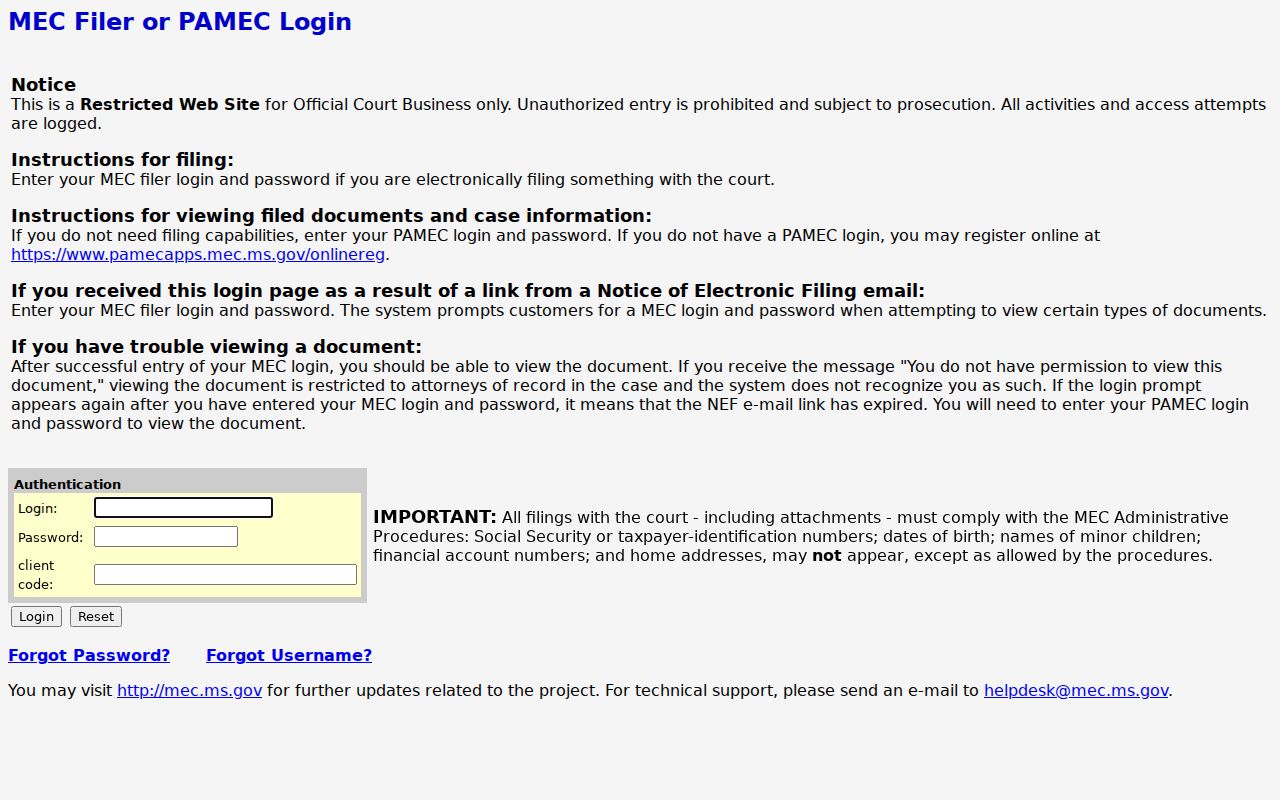
The login screen tells the story. When a document stays out of reach, take it to the clerk rather than forcing it through a public search.
Public Access and Sealed Criminal Dockets
Mississippi's public-records law leans toward letting people inspect records. Still, an Attala County criminal docket answer to court restrictions and privacy rules. PAMEC remote access demands credentials and charges per page. Free electronic viewing at the right clerk's office is a different route. Paper, certified, search, review, redaction, and mailing costs can all apply. The county posts no separate criminal certification schedule, so ask what a certified copy will cost.
Frame any public-records request with care. Name the office, the court, and the date range. Add the record type and the format you want. If staff must search, review, redact, certify, or mail, request an estimate first. One more wrinkle deserves care. A restricted document can appear as a docket entry with no public contents. Personal identifiers and protected material get special handling. A closure order does not make every document available.
Key Rules:
Miss. Code §§ 25-61-1 and 25-61-2 state the policy favoring access to public records unless an exception applies.
Miss. Code § 25-61-5 addresses public-record request, access, and response procedures.
Miss. Code § 25-61-7 permits actual search, review, duplication, and mailing costs, with payment in advance in some circumstances.
MEC Administrative Procedures, Sections 7-8 distinguish PAMEC remote access from free electronic viewing at the clerk's office.
Before filing an Attala request, confirm the governing access text at the official Mississippi Public Records Act page. That is the state's own statement of the rules.
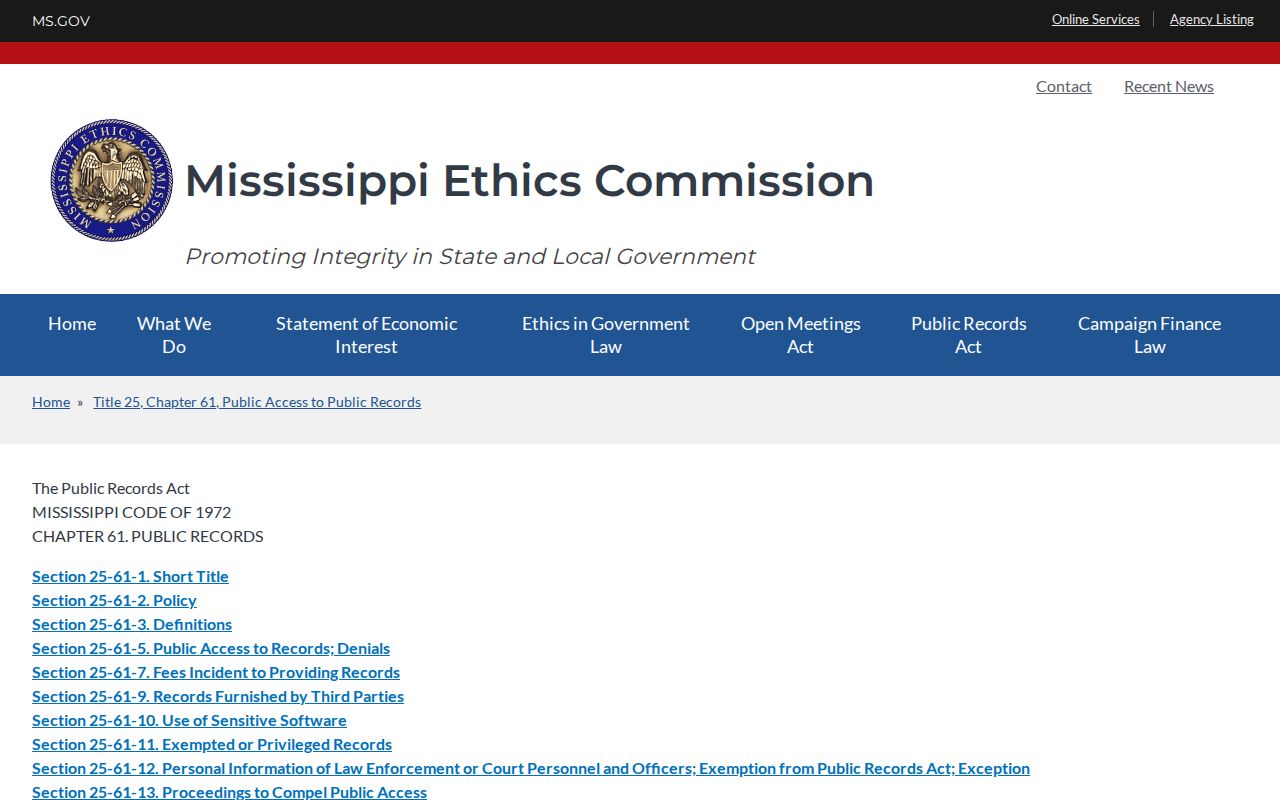
The state statute can back up a request to the right Attala office. It cannot lift a sealing order or attorney-of-record limits.
Attala County Criminal Docket Timeline Reading
Think of an Attala County criminal docket as a running timeline, not a verdict. Read it in order. Begin with the Attala court plus the filing or indictment date, then work forward through the charge description, attorney appearances, arraignment, motions, and settings. Later lines may hold a judgment, sentence, appeal, probation entry, or a note closing the case. Each Attala entry's date and source matter. One docket can pair a filed notice with a much later order about the very same event.
Keep the labels in perspective. A charge is a filed allegation, not a conviction. A warrant or capias flag marks workflow, not proof of service. A plea-pending or trial-pending label is not a finding. For an Attala County criminal docket, the soundest public reading sets the current flag beside the dated order or judgment behind it. Is a document missing or restricted? The Attala Circuit Clerk can tell you whether a public docket sheet or an ordinary copy exists.
Note: Do not treat an earlier Attala docket event as controlling. A later court order may change the setting, status, or disposition.